
Understanding butterfly valve flow characteristics is important when selecting, sizing, and operating a valve for an industrial piping system. Although butterfly valves have a relatively simple design, the relationship between valve opening and flow isn’t linear in every application.
The disc position, valve size, pressure differential, fluid properties, piping arrangement, and valve design all affect actual flow performance.
A butterfly valve can be used for simple isolation, but it can also provide flow regulation when the valve and application are properly selected. However, using an isolation valve as a control valve without considering its flow characteristics can lead to poor control, excessive pressure drop, vibration, or premature wear.
This guide explains how butterfly valves affect flow, how valve opening relates to flow rate, what Cv means, how pressure drop changes, and how to select a suitable butterfly valve for an application.
For industrial projects requiring flanged connections, you can also explore our flanged valve product range.
What Are Butterfly Valve Flow Characteristics?
Flow characteristics describe the relationship between valve position and flow capacity under defined operating conditions.
For a butterfly valve, the disc rotates inside the pipeline.
- At approximately 0°, the valve is closed.
- As the disc rotates, the available flow area increases.
- Near the fully open position, the flow passage becomes relatively large.
However, the relationship between disc angle and actual flow isn’t simply:
50% open = 50% flow.
That’s an important point.
The actual flow depends on the pressure differential and system resistance as well as the valve’s geometry.
A valve opening of 50% can produce very different flow rates in two different piping systems.
How a Butterfly Valve Controls Flow
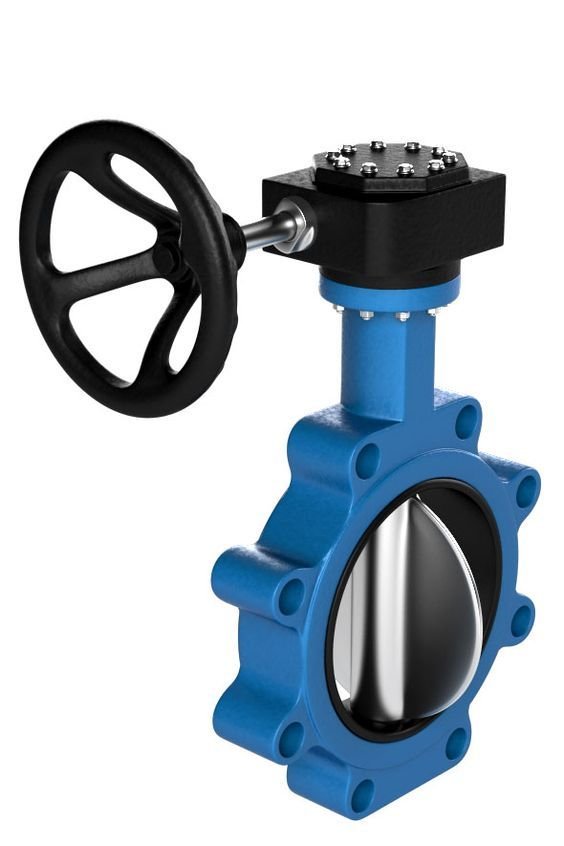
A butterfly valve controls flow by rotating a disc around its shaft.
When the disc is perpendicular to the pipe, flow is blocked.
As the disc rotates toward the open position, the effective flow area increases.
A simplified relationship is:
Flow rate depends on valve capacity, pressure differential, and fluid properties.
For liquids, a commonly used relationship is:
Q ∝ Cv × √(ΔP / SG)
where:
- Q = flow rate
- Cv = valve flow coefficient
- ΔP = pressure differential
- SG = specific gravity
The actual equation and units depend on the applicable sizing method.
The key takeaway is that valve position alone doesn’t determine flow rate.
Butterfly Valve Flow Characteristics vs Valve Opening
Butterfly valves generally don’t provide a perfectly linear relationship between disc angle and flow.
At small openings, a relatively small change in disc position can produce a significant change in flow.
As the valve approaches the fully open position, additional disc rotation may produce a smaller change in flow capacity.
This means that the useful control range isn’t necessarily evenly distributed across the full 0°–90° rotation.
Typical Behavior
| Valve Position | General Flow Behavior |
|---|---|
| 0° | Closed |
| 10°–20° | Low flow |
| 30°–40° | Flow increasing rapidly |
| 50°–60° | Moderate/high flow |
| 70°–80° | High flow |
| 90° | Fully open |
These are general illustrations rather than universal flow values.
Actual performance should always be taken from the manufacturer’s Cv data.
What Is Butterfly Valve Cv?
Cv is a measure of a valve’s flow capacity.
For liquid sizing under commonly used U.S. customary conventions, Cv is defined in terms of the water flow rate in US gallons per minute that produces a 1 psi pressure drop across the valve under specified reference conditions.
A higher Cv generally indicates greater flow capacity.
For a butterfly valve, Cv varies with:
- Valve size
- Disc angle
- Valve design
- Pressure differential
- Fluid properties
Manufacturers typically provide Cv tables or curves showing how capacity changes as the disc opens.
Butterfly Valve Cv and Flow Rate
Cv is especially useful during valve sizing.
Suppose an engineer knows:
- Required flow rate
- Fluid specific gravity
- Available pressure drop
The required valve capacity can then be estimated using the appropriate sizing equation.
A valve that is too small may create:
- Excessive pressure drop
- High velocity
- Noise
- Vibration
- Increased wear
A valve that is too large may create poor control resolution because a small movement can cause a large change in flow.
Therefore, bigger isn’t automatically better.
Butterfly Valve Pressure Drop
Every valve creates some pressure loss when fluid passes through it.
Pressure drop depends on:
- Valve opening
- Flow rate
- Valve size
- Fluid density
- Valve geometry
- Pipeline configuration
A fully open butterfly valve generally has relatively low pressure loss compared with many globe-style control valves, which is one reason butterfly valves are popular for large-diameter piping.
However, the pressure drop increases significantly as the disc moves toward the closed position.

Why Pressure Drop Matters
Excessive pressure loss can:
- Increase pumping energy
- Reduce downstream pressure
- Increase flow velocity
- Create noise
- Increase vibration
- Affect process performance
The valve should therefore be sized using actual system requirements rather than pipe diameter alone.
Butterfly Valve Flow Characteristics for Throttling
Butterfly valves can regulate flow, but not every butterfly valve is equally suitable for throttling.
For basic applications, a conventional resilient seated butterfly valve may provide adequate control.
For demanding control applications, a purpose-designed control butterfly valve may be more appropriate.
Consider:
- Required control range
- Flow variation
- Pressure differential
- Cavitation risk
- Noise
- Fluid velocity
- Required accuracy
If the process requires precise flow control across a broad operating range, a valve specifically designed for control service may provide better performance.
Concentric Butterfly Valve Flow Characteristics
Concentric butterfly valves are widely used for general-purpose flow isolation.
They are commonly found in:
- Water treatment
- HVAC
- Cooling water
- Irrigation
- General industrial service
Their relatively simple geometry provides good flow capacity when fully open.
However, when used for throttling, the disc can create substantial turbulence and velocity changes depending on the opening position.
For this reason, application-specific sizing is important.
Double Offset Butterfly Valve Flow Characteristics
A double offset butterfly valve moves the shaft away from the centerline of the disc and sealing geometry.
This reduces sliding contact between the disc and seat during operation.
Benefits can include:
- Lower friction
- Reduced seat wear
- Improved durability
- Better performance at higher pressures
Double offset valves may be used for applications requiring more demanding performance than conventional concentric designs.
Their actual flow characteristics should still be evaluated using manufacturer-supplied Cv data.
Triple Offset Butterfly Valve Flow Characteristics
Triple offset butterfly valves use an additional geometric offset that creates a cam-like disc movement away from the seat.
This can significantly reduce rubbing between sealing surfaces.
Triple offset valves are commonly considered for:
- High temperature
- High pressure
- Critical isolation
- Steam
- Severe industrial applications
Because their geometry differs significantly from conventional butterfly valves, their flow characteristics and torque behavior should be evaluated using the manufacturer’s technical data.
Butterfly Valve Flow Coefficient and Valve Size
Valve size has a direct impact on flow capacity.
For the same general valve design:
Larger valve → generally higher flow capacity
But selecting a valve based solely on pipe diameter isn’t sufficient.
For example, a DN200 pipeline doesn’t automatically mean a DN200 butterfly valve is the best choice.
The engineer should consider:
- Minimum flow
- Normal flow
- Maximum flow
- Pressure drop
- Fluid properties
- Control range
- Valve authority
- Operating conditions
In some systems, a properly selected smaller valve may provide better control than simply matching the pipeline diameter.
Butterfly Valve Flow Characteristics and Valve Sizing
Correct sizing is critical.
A practical sizing process should include:
Step 1: Determine the Required Flow
Establish:
- Minimum flow
- Normal flow
- Maximum flow
Step 2: Determine Fluid Properties
Consider:
- Density
- Specific gravity
- Viscosity
- Temperature
- Vapor pressure
Step 3: Determine Available Pressure Differential
Calculate the pressure available across the valve at the relevant flow conditions.
Step 4: Calculate Required Cv
Use the applicable valve-sizing equation.
Step 5: Check Valve Opening
Verify that the selected valve operates in a useful portion of its characteristic curve.
Step 6: Check Velocity and Pressure Drop
Make sure the selected valve doesn’t create unacceptable hydraulic conditions.
Step 7: Check Actuator Torque
Confirm that the actuator can operate the valve under the maximum differential pressure.
Why a Butterfly Valve May Not Deliver the Expected Flow
If actual flow differs significantly from the expected flow, investigate several factors.
Possible causes include:
- Incorrect valve size
- Incorrect disc position
- Incorrect Cv data
- Insufficient upstream pressure
- Excessive downstream pressure
- Pipeline restrictions
- Dirty filters
- Incorrect flow-meter calibration
- Fluid properties different from design conditions
The valve itself may be functioning correctly.
A flow problem should therefore be evaluated as a complete system problem, not just a valve problem.
Butterfly Valve Flow Characteristics and Cavitation
Cavitation can occur when local fluid pressure falls below the fluid’s vapor pressure and vapor bubbles subsequently collapse as pressure recovers.
Potential consequences include:
- Noise
- Vibration
- Surface damage
- Reduced valve life
- Unstable flow
Cavitation risk should be evaluated when butterfly valves operate at high pressure differentials, particularly in liquid service.
If cavitation is a concern, review:
- Valve pressure drop
- Fluid temperature
- Vapor pressure
- Flow rate
- Valve opening
- Downstream pressure
A different valve design or system configuration may be necessary for severe conditions.
Butterfly Valve Flow Characteristics and Noise
Noise generally increases when fluid velocity and turbulence increase.
Potential sources include:
- High flow velocity
- Large pressure drop
- Unfavorable valve position
- Cavitation
- Gas entrainment
- Mechanical vibration
A butterfly valve operating near a partially closed position may create substantially different hydraulic conditions from the same valve operating fully open.
If noise is a concern, evaluate the complete piping system rather than focusing only on the valve.
Butterfly Valve Flow Characteristics for Water Systems
Water applications are among the most common uses for butterfly valves.
Typical services include:
- Drinking water
- Cooling water
- Wastewater
- Irrigation
- Fire protection
- Water treatment
- Desalination
For these applications, engineers typically consider:
- Flow rate
- Pressure loss
- Valve size
- Seat material
- Corrosion resistance
- Operating frequency
In large-diameter water pipelines, the relatively compact construction of butterfly valves can provide an attractive combination of flow capacity, weight, and cost.
Butterfly Valve Flow Characteristics for Steam and High-Temperature Service
High-temperature service requires more careful valve selection.
Important factors include:
- Temperature rating
- Pressure rating
- Seat design
- Thermal expansion
- Material compatibility
- Actuator torque
Metal-seated and triple offset butterfly valves may be appropriate for some high-temperature services.
However, the valve should be selected using actual pressure-temperature conditions and manufacturer performance data.
Butterfly Valve Flow Characteristics vs Globe Valve
Butterfly and globe valves can both be used for flow control, but their hydraulic characteristics and application strengths differ.
| Feature | Butterfly Valve | Globe Valve |
|---|---|---|
| Compactness | Excellent | Moderate |
| Weight | Low | Higher |
| Large diameter | Very suitable | Can be heavy |
| Full-open pressure loss | Generally low | Generally higher |
| Throttling | Application-dependent | Commonly strong |
| Cost at large sizes | Often favorable | Often higher |
| Installation space | Compact | More space required |
For large-diameter systems where pressure loss and compactness matter, butterfly valves can be particularly attractive.
For demanding throttling and precise control, a globe valve may be more suitable depending on the process.
How to Improve Butterfly Valve Flow Performance
Several practices can improve hydraulic performance.
Select the Correct Valve Size
Don’t simply match valve size to pipe size without calculating the required capacity.
Use Manufacturer Cv Data
Actual valve curves are more useful than generic assumptions.
Avoid Unnecessary Pressure Drop
Select a valve that provides the required flow without creating excessive resistance.
Consider Valve Position
A valve that operates almost fully closed or fully open for long periods may not be ideal for its intended duty.
Check Piping Layout
Upstream and downstream fittings can influence flow distribution and pressure loss.
Monitor Actual Flow
Compare field measurements with design expectations.
Butterfly Valve Flow Characteristics Checklist
Before selecting a butterfly valve for a flow application, verify:
- Minimum flow
- Normal flow
- Maximum flow
- Fluid type
- Fluid temperature
- Specific gravity
- Viscosity
- Upstream pressure
- Downstream pressure
- Required pressure drop
- Required Cv
- Valve size
- Valve opening range
- Control requirements
- Cavitation risk
- Noise requirements
- Actuator torque
- Manufacturer Cv curve
Frequently Asked Questions
What are butterfly valve flow characteristics?
They describe how the valve’s flow capacity changes as the disc moves from closed to fully open. The actual flow also depends on pressure differential, fluid properties, valve size, and piping conditions.
Is butterfly valve flow linear?
Not necessarily. The relationship between disc angle and flow capacity is generally nonlinear, and the actual installed flow characteristic also depends on the piping system.
What is Cv in a butterfly valve?
Cv is a flow-capacity coefficient used in valve sizing. Under commonly used U.S. customary conventions for liquids, it relates water flow rate to a specified pressure drop under reference conditions.
Does a larger butterfly valve always provide better flow?
A larger valve generally has greater flow capacity, but oversized valves can provide poor control resolution and may not operate in the most useful range. Proper sizing is more important than simply choosing the largest available valve.
Can butterfly valves be used for throttling?
Yes, depending on the valve design and application. However, continuous throttling can create turbulence, vibration, noise, or accelerated wear if the valve isn’t suitable for that duty.
What causes high pressure drop across a butterfly valve?
Possible causes include undersizing, partial closure, excessive flow, internal obstruction, or unfavorable operating conditions.
How do I calculate butterfly valve flow rate?
The calculation generally uses the valve’s Cv or an equivalent flow coefficient together with pressure differential and fluid properties. The exact equation depends on whether the medium is liquid, gas, or steam and which sizing standard is being used.
Why does actual flow differ from the calculated flow?
Possible reasons include inaccurate pressure measurements, incorrect fluid properties, pipeline restrictions, incorrect valve position, inaccurate Cv data, or changes in system operating conditions.
Which butterfly valve is best for flow control?
The answer depends on the application. Conventional concentric valves may work well for basic regulation, while purpose-designed control, double-offset, or other specialized butterfly valves may be more appropriate for demanding applications.
Conclusion
Understanding butterfly valve flow characteristics is essential for proper valve sizing and reliable flow control. The relationship between disc position and flow isn’t simply proportional, and actual performance depends on the complete hydraulic system.
When selecting a butterfly valve, consider flow rate, Cv, pressure drop, valve size, fluid properties, operating position, cavitation, noise, and actuator torque. Manufacturer-supplied Cv tables and flow curves should be used whenever available.
For basic isolation applications, a conventional butterfly valve can provide excellent flow capacity with relatively low pressure loss. For demanding throttling, high-pressure, or high-temperature applications, a more specialized valve design may be appropriate.
The goal isn’t to select the biggest valve or the valve with the highest possible Cv. The goal is to select a valve that operates reliably within the required flow range while providing acceptable pressure loss, control performance, and service life.