
Butterfly Valve Pressure Drop: What Does It Mean?
Butterfly valve pressure drop refers to the difference between the fluid pressure immediately upstream and downstream of a butterfly valve while fluid is flowing through it. It is an important factor in pipeline design because every valve creates some resistance to flow.
A butterfly valve generally has a relatively compact flow path, but its disc remains inside the pipeline even when the valve is fully open. As a result, it creates more flow resistance than a full-bore valve such as a full-port ball valve.
However, this doesn’t mean butterfly valves always have high pressure loss. In many large-diameter water and industrial piping systems, they remain a practical choice because they are lightweight, compact, and economical. Published data show that pressure loss varies with valve type, size, opening position, and operating conditions rather than being one fixed value.
For engineers, the key question isn’t simply whether a butterfly valve has pressure drop. The real question is whether the pressure loss is acceptable for the required flow rate and system pressure.
How Is Butterfly Valve Pressure Drop Calculated?
Pressure drop depends mainly on flow rate, fluid density, valve geometry, and valve flow capacity.
For liquid applications, engineers commonly use the valve’s Cv or Kv value. Cv describes the valve’s flow capacity in U.S. customary units, while Kv is the metric flow coefficient. A higher flow coefficient generally indicates greater flow capacity and therefore lower pressure loss at a given flow rate.
For water and other liquids, a commonly used relationship is:
Where:
- Cv = flow coefficient
- q = flow rate
- SG = specific gravity
- ΔP = pressure drop across the valve
For a given valve and fluid, increasing flow rate generally increases pressure loss. Conversely, increasing the valve’s effective flow capacity can reduce pressure drop.
For actual engineering selection, the manufacturer’s certified Cv/Kv data should be used rather than relying on a generic table. Published butterfly-valve data show that Cv can change substantially as the disc moves away from the fully open position.
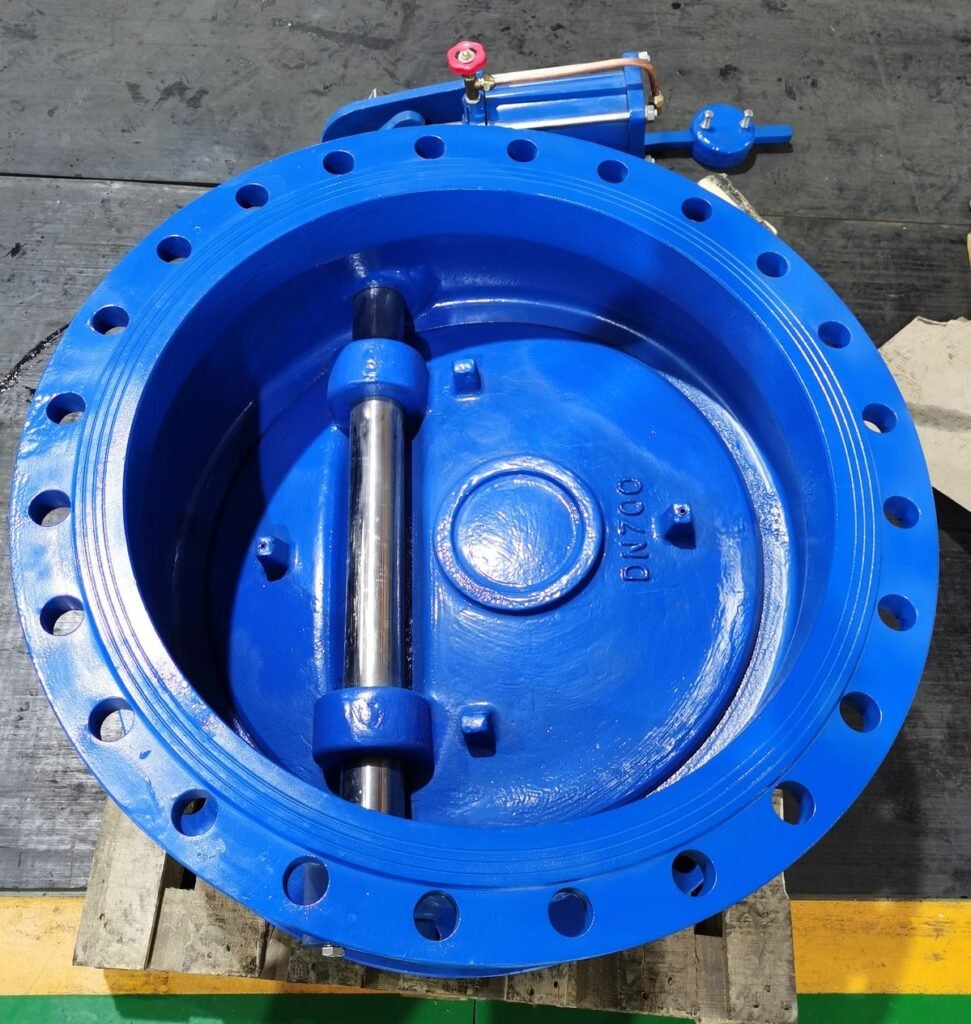
What Is the Pressure Drop of a Butterfly Valve?
There is no single pressure-drop value that applies to every butterfly valve.
Pressure loss depends on:
| Factor | Effect on Pressure Drop |
|---|---|
| Valve size | Larger effective flow area can reduce loss |
| Flow rate | Higher flow usually increases loss |
| Valve opening | Partially closed valves create more resistance |
| Disc design | Disc thickness and profile affect turbulence |
| Valve type | Wafer, lug, flanged and offset designs can differ |
| Fluid density | Affects hydraulic resistance |
| Seat design | Can influence the flow passage |
| Pipe configuration | Upstream/downstream fittings affect total loss |
For example, published typical butterfly-valve Cv data show that a DN100 valve may have a much higher Cv when fully open than when operating around 30° open. This demonstrates why valve position matters when estimating pressure loss.
Therefore, manufacturers should provide pressure-loss curves or Cv/Kv data for the specific valve model.
Why Does Butterfly Valve Pressure Drop Increase at Partial Opening?
The disc is the main reason.
When a butterfly valve is fully open, the disc is approximately parallel to the direction of flow. Although the disc still occupies part of the flow passage, the available area is relatively large.
As the valve begins to close, the disc moves across the flow path. This creates:
- A smaller effective flow area
- Higher local velocity
- More turbulence
- Greater flow resistance
- Higher pressure loss
The effect becomes especially important when the valve is used for throttling rather than simple isolation.
Typical published Cv data demonstrate a strong reduction in flow capacity as disc angle decreases. For example, the Engineering ToolBox data show much higher Cv values at 90° open than at 30° open for the listed valve sizes.
That’s why a butterfly valve should not automatically be selected by matching the pipeline diameter alone.
Butterfly Valve Pressure Drop at Full Open
A fully open butterfly valve generally produces its lowest pressure loss within its normal operating range.
However, “fully open” doesn’t mean “zero pressure drop.” The disc, shaft, seat, and body geometry still interact with the flowing medium.
A useful engineering approach is to compare the valve’s full-open flow capacity with the required system flow.
For example, a cooling-water pipeline may require a high flow rate with minimal available pump head. In this situation, selecting a valve with insufficient flow capacity could create unnecessary pressure loss.
On the other hand, selecting a valve that is excessively oversized can create poor control characteristics if the valve is intended for throttling.
The goal is therefore not simply the lowest possible pressure drop. The goal is an appropriate balance between flow capacity, controllability, operating torque, cost, and service life.
Butterfly Valve Pressure Drop vs Other Valve Types
Butterfly valves are often compared with gate, globe, and ball valves.
| Valve Type | Typical Flow Resistance | Main Strength |
| Butterfly | Low to moderate | Compact and economical |
| Gate | Very low when fully open | Isolation |
| Full-port ball | Very low | High flow capacity |
| Globe | Higher | Excellent throttling |
| Check valve | Depends strongly on design | Prevents reverse flow |
Published valve-selection data illustrate that butterfly valves can have higher pressure loss than gate or full-bore ball valves, while offering major advantages in size, weight, and cost for large pipelines.
For large water pipelines, this trade-off can be very attractive.
How Valve Size Affects Pressure Drop
Valve diameter has a major effect on pressure loss.
Suppose two valves carry the same flow rate but have different nominal diameters. The smaller valve will generally have a higher flow velocity through its restricted area, which can result in greater pressure loss.
This is one reason engineers should consider the actual required flow rate rather than selecting a valve solely based on the existing pipe diameter.
However, oversizing isn’t always the best answer.
An oversized butterfly valve may operate at a very small opening during normal conditions. This can make flow control less predictable and may increase sensitivity to changes in valve position.
For isolation service, matching the pipeline size is common. For control service, detailed sizing using Cv/Kv and operating conditions is more appropriate.
How Cv and Kv Help Determine Pressure Loss
Cv and Kv are among the most useful specifications when evaluating butterfly valve pressure drop.
Cv is traditionally expressed using U.S. customary units, while Kv is commonly used in metric applications. The definitions are based on the amount of water that passes through a valve at a specified pressure differential.
A valve manufacturer may provide a table such as:
| Disc Position | Relative Flow Capacity |
| Fully Open | Highest |
| 70° | High |
| 50° | Medium |
| 30° | Low |
| Nearly Closed | Very Low |
The actual values vary by valve design and manufacturer.
Engineering ToolBox’s published butterfly-valve data, for example, show substantial differences in Cv between 90°, 70°, 50°, and 30° positions.
This information allows engineers to determine whether a particular valve can provide the required flow without consuming excessive pressure head.
How to Reduce Butterfly Valve Pressure Drop
If pressure loss is too high, several design approaches can help.
1. Select the Correct Valve Size
A valve with greater flow capacity can reduce pressure loss at the required flow rate.
2. Use an Appropriate Disc Design
Different butterfly valve designs have different internal flow characteristics.
3. Avoid Unnecessary Throttling
If the valve is normally operated close to the closed position, pressure loss can rise considerably.
4. Check the Cv/Kv Curve
Don’t rely solely on nominal diameter. Review the manufacturer’s flow coefficient data at the expected operating position.
5. Consider the Complete Piping System
Elbows, reducers, strainers, check valves, and other fittings also contribute to total pressure loss.
6. Verify Pump Head
The valve pressure drop must be considered together with the pump’s available head.
Pressure Drop in Water Applications
Water systems are among the most common applications for butterfly valves.
Typical examples include:
- Drinking water pipelines
- Cooling water systems
- Wastewater treatment
- Irrigation
- Fire protection
- HVAC chilled-water systems
- Desalination plants
For these applications, engineers typically know the required flow rate and allowable pressure drop. These two parameters can then be used to determine the required valve flow coefficient.
Industry valve-sizing guidance also emphasizes that both flow rate and differential pressure are needed for proper valve sizing.
For a water system, a simplified design process is:
Required flow → allowable pressure drop → required Cv/Kv → valve size → operating position
This approach is more reliable than simply choosing a valve that matches the pipe diameter.
Pressure Drop in Oil and Gas Applications
Oil and gas systems require additional consideration because hydrocarbons and gases behave differently from water.
Important factors include:
- Fluid density
- Viscosity
- Pressure
- Temperature
- Gas compressibility
- Flow velocity
- Required leakage class
- Valve pressure rating
For gas service, the pressure-drop calculation cannot simply use the same liquid equation without considering compressibility.
For critical applications, engineers should use recognized valve-sizing standards and manufacturer-certified data.
Pressure Drop and Cavitation
Excessive pressure reduction across a valve can create additional problems in liquid systems.
When local pressure falls sufficiently low, vapor bubbles may form and then collapse as pressure recovers. This phenomenon is known as cavitation.
Potential consequences include:
- Noise
- Vibration
- Surface erosion
- Reduced valve life
- Unstable flow
Therefore, minimizing pressure drop isn’t the only concern. Engineers must also evaluate where the pressure reduction occurs and whether the resulting downstream pressure is suitable for the fluid.
Valve-sizing guidance for water systems specifically notes the importance of pressure drop and the potential effects of cavitation and flashing.
Butterfly Valve Pressure Drop and Valve Authority
When a butterfly valve is used for control rather than simple isolation, valve authority can become important.
Valve authority compares the pressure drop across the control valve with the total pressure drop in the circuit. A commonly used expression is:
A higher authority generally means the valve has a stronger influence over the system’s flow behavior. Published engineering guidance commonly considers an authority of at least 0.5 desirable for good control, although the appropriate value depends on the application.
This is another reason why the smallest possible pressure drop isn’t always ideal for a control valve.
How to Select a Butterfly Valve Based on Pressure Drop
When selecting a butterfly valve, collect the following information:
| Parameter | Example |
| Fluid | Water |
| Flow rate | 500 m³/h |
| Pipe size | DN300 |
| Upstream pressure | Project-specific |
| Downstream pressure | Project-specific |
| Allowable pressure loss | Project-specific |
| Temperature | Project-specific |
| Valve function | Isolation or control |
| Operating position | Fully open or throttling |
Then request the manufacturer’s:
- Cv/Kv data
- Pressure-loss curve
- Torque data
- Pressure rating
- Temperature rating
- Leakage specification
- Material specification
The manufacturer’s technical data should always take priority over generic butterfly-valve tables when making a final selection.
Flanged Butterfly Valve and Pressure Drop
A flanged butterfly valve is frequently used in large industrial and municipal pipelines. Its pressure drop is determined primarily by the internal valve geometry, disc position, flow rate, and valve size—not simply by the flange connection itself.
Flanged designs are popular for:
- Large water pipelines
- Cooling water systems
- Pump stations
- Industrial process lines
- Desalination systems
- Fire protection systems
For large-diameter applications, the combination of compact valve construction and relatively high flow capacity can make butterfly valves an attractive alternative to heavier valve designs.
7 Key Factors That Affect Butterfly Valve Pressure Drop
To summarize, engineers should pay particular attention to these seven factors:
- Flow rate — higher flow generally produces higher pressure loss.
- Valve size — an appropriately sized valve can reduce unnecessary resistance.
- Disc position — partially closed valves usually produce much greater resistance.
- Cv/Kv value — indicates the valve’s flow capacity.
- Valve design — disc, shaft, seat, and body geometry affect flow.
- Fluid properties — density and viscosity influence pressure loss.
- System configuration — fittings and adjacent piping also contribute to total loss.
Looking at all seven factors provides a much more accurate picture than quoting one generic pressure-drop number.
Frequently Asked Questions
What is butterfly valve pressure drop?
Butterfly valve pressure drop is the difference between upstream and downstream pressure while fluid flows through the valve.
Do butterfly valves have high pressure drop?
Generally, butterfly valves can provide relatively low pressure loss when fully open, especially compared with many throttling valve designs. However, the actual loss depends on valve size, disc position, flow rate, and internal design.
Does a fully open butterfly valve still cause pressure loss?
Yes. Even when fully open, the disc and other internal components remain in the flow path, so some pressure loss occurs.
Why does pressure drop increase when a butterfly valve closes?
Closing the disc reduces the effective flow area and increases turbulence and flow resistance.
What is Cv in a butterfly valve?
Cv is a flow-capacity coefficient used to describe how much fluid a valve can pass for a specified pressure differential. Kv is the commonly used metric counterpart.
How can I reduce butterfly valve pressure drop?
Use an appropriately sized valve, select a suitable flow-path design, avoid unnecessary throttling, and verify the manufacturer’s Cv/Kv and pressure-loss data.
Is butterfly valve pressure drop important for pump selection?
Yes. The pressure loss across the valve contributes to the total system pressure requirement and therefore affects the pump head available for the required flow.
Can butterfly valves be used for flow control?
Yes, but the valve should be properly sized for the intended control range. A valve that is oversized or operated mostly near closed position may not provide ideal control performance.
Where can I find accurate pressure-drop data?
The best source is the valve manufacturer’s technical documentation, including pressure-loss curves or Cv/Kv tables for the exact valve design and size. Generic tables can be useful for preliminary estimates, but they shouldn’t replace product-specific data.
Conclusion
Understanding butterfly valve pressure drop is essential for proper pipeline and valve selection. Although butterfly valves are known for their compact construction and economical large-diameter design, their actual pressure loss depends on several factors, especially flow rate, valve size, disc position, valve geometry, and fluid properties.
For isolation service, a properly sized butterfly valve can provide efficient flow with relatively low resistance when fully open. For control applications, engineers should pay closer attention to Cv/Kv, operating position, valve authority, cavitation risk, and the overall hydraulic balance of the system.
The most reliable approach is simple: define the operating conditions first, calculate the required flow capacity, and then select the butterfly valve using manufacturer-specific pressure-loss and Cv/Kv data. This helps achieve efficient operation without unnecessarily sacrificing pump head or system performance.
Recommended External Reference
For additional information on valve sizing and flow coefficients, see Spirax Sarco’s guide to control valve sizing for water systems.