
What Is a Butterfly Valve Cv Chart?
A butterfly valve Cv chart shows the flow capacity of a butterfly valve at different valve sizes and opening positions. Cv, or flow coefficient, is a standard way to describe how much water can pass through a valve at a specified pressure differential.
In U.S. customary units, Cv represents the number of U.S. gallons per minute of water at 60°F that flow through a valve with a 1 psi pressure drop. The metric equivalent, Kv, expresses flow in cubic meters per hour of water with a 1 bar pressure drop.
Cv is especially useful when selecting a butterfly valve for:
- Water treatment
- Cooling water
- HVAC
- Irrigation
- Desalination
- Chemical processing
- Industrial process pipelines
- Flow-control systems
A Cv chart isn’t simply a list of valve sizes. It also shows how dramatically flow capacity can change as the disc moves from nearly closed to fully open.
How Does Cv Work in a Butterfly Valve?
The basic concept is straightforward: a higher Cv means greater flow capacity for a given pressure differential.
For liquids, a simplified relationship can be expressed as:
Where:
- Cv = flow coefficient
- Q = flow rate in U.S. gallons per minute
- SG = specific gravity of the liquid
- ΔP = pressure drop across the valve in psi
For water, SG is approximately 1 under typical conditions, so the calculation becomes easier.
For example, if a water system requires a flow rate of 500 GPM and the allowable valve pressure drop is 4 psi:
This means the valve would need a Cv of approximately 250 under those simplified conditions.
For actual valve selection, engineers should use the manufacturer’s tested Cv/Kv data and account for the exact fluid, operating pressure, temperature, valve design, and required opening position.
Butterfly Valve Cv Chart by Opening Angle
One of the most important things to understand is that Cv isn’t linear with valve opening.
A published reference table for concentric butterfly valves gives the following example values:
| Valve Size | 30° Open | 50° Open | 70° Open | 80° Open | 90° Open |
|---|---|---|---|---|---|
| 2 in / DN50 | 12 | 45 | 90 | 125 | 135 |
| 3 in / DN80 | 22 | 70 | 183 | 275 | 302 |
| 4 in / DN100 | 36 | 139 | 364 | 546 | 600 |
| 6 in / DN150 | 95 | 366 | 958 | 1,437 | 1,579 |
| 8 in / DN200 | 188 | 727 | 1,903 | 2,854 | 3,136 |
| 10 in / DN250 | 320 | 1,237 | 3,240 | 4,859 | 5,340 |
| 12 in / DN300 | 495 | 1,911 | 5,005 | 7,507 | 8,250 |
These figures are reference values from a published valve-flow table, not universal values for every butterfly valve. The same source specifically notes that Cv doesn’t progress linearly and shouldn’t simply be extrapolated.
The pattern is nevertheless important: moving a butterfly valve from 70% toward fully open can produce a very large increase in flow capacity.
Why Does Butterfly Valve Cv Change With Opening?
The disc controls the effective flow area.
When the valve is nearly closed, the disc blocks most of the pipeline passage. Flow is restricted and the Cv is relatively low.
As the disc rotates open:
- The effective flow area increases.
- Flow resistance decreases.
- Flow capacity increases.
- Cv rises.
But the relationship isn’t a simple straight line.
For example, the published DN100 concentric butterfly valve data show Cv increasing from 36 at 30° to 139 at 50°, then to 364 at 70°, and 600 at 90°.
This is why engineers shouldn’t assume that a valve 50% open provides exactly 50% of its full-open flow capacity.
Butterfly Valve Cv Chart for Common Sizes
The following simplified table provides selected reference values from the published concentric-valve data.
| Size | 30° | 40° | 50° | 60° | 70° | 80° | 90° |
|---|---|---|---|---|---|---|---|
| DN50 | 12 | 24 | 45 | 64 | 90 | 125 | 135 |
| DN80 | 22 | 39 | 70 | 116 | 183 | 275 | 302 |
| DN100 | 36 | 78 | 139 | 230 | 364 | 546 | 600 |
| DN150 | 95 | 205 | 366 | 605 | 958 | 1,437 | 1,579 |
| DN200 | 188 | 408 | 727 | 1,202 | 1,903 | 2,854 | 3,136 |
| DN250 | 320 | 694 | 1,237 | 2,047 | 3,240 | 4,859 | 5,340 |
| DN300 | 495 | 1,072 | 1,911 | 3,162 | 5,005 | 7,507 | 8,250 |
These numbers are useful for understanding the trend, but the exact Cv for a valve should always come from the manufacturer’s product data.
Visualizing How Cv Changes With Valve Opening
The published DN100 reference values provide a useful example of the relationship between opening angle and flow capacity.
DN100 butterfly valve Cv versus opening angle
Reference Cv values for a published concentric butterfly valve at selected disc opening angles.020040060080030°40°50°60°70°80°90°
Reference data; actual Cv varies by valve design and manufacturer.
The curve shows why butterfly valves can behave very differently at partial openings. A small change in disc position near the upper part of the operating range can produce a significant change in flow capacity.
Cv vs Kv: What’s the Difference?
Cv and Kv describe essentially the same concept but use different unit systems.
| Parameter | Cv | Kv |
|---|---|---|
| Unit system | U.S. customary | Metric |
| Reference fluid | Water | Water |
| Flow unit | US gal/min | m³/h |
| Pressure differential | 1 psi | 1 bar |
| Common usage | North America and international projects | Europe and metric markets |
A commonly used approximate conversion is:
The exact conversion should be checked against the conventions used in the relevant project or manufacturer’s documentation.
How to Use a Butterfly Valve Cv Chart
Using a Cv chart generally involves five steps.
Step 1: Determine the Required Flow Rate
Establish the normal, minimum, and maximum flow rates.
For example:
- Minimum flow: 100 m³/h
- Normal flow: 250 m³/h
- Maximum flow: 350 m³/h
Step 2: Determine the Allowable Pressure Drop
Find out how much pressure loss the system can tolerate across the valve.
Step 3: Determine Fluid Properties
For liquids, consider:
- Density
- Specific gravity
- Temperature
- Viscosity
Step 4: Calculate the Required Cv or Kv
Use the appropriate valve-sizing equation.
Step 5: Compare With Manufacturer Data
Check the required flow against the valve’s Cv at the expected operating position.
This final step is critical. A valve with sufficient full-open Cv may still be unsuitable if the application requires it to operate almost closed.
How Valve Size Affects Cv
Valve size has a major influence on Cv.
The published reference data show a strong increase in full-open Cv as valve diameter increases. For example, the listed full-open Cv increases from 600 for DN100 to 8,250 for DN300 in the concentric butterfly valve table.
This makes butterfly valves particularly attractive for large-diameter pipelines.
However, larger isn’t automatically better.
An oversized valve may have an extremely high Cv compared with the system’s actual requirement. If it then operates near the closed position, flow control may become less predictable.
The best selection balances:
Required flow + allowable pressure drop + operating range + valve size
Butterfly Valve Cv Chart and Pressure Drop
Cv is directly related to pressure loss.
For the same fluid and flow rate:
Higher Cv → lower required pressure drop
Lower Cv → higher required pressure drop
This makes Cv particularly useful when evaluating pump systems.
Suppose a pump has limited available head. Selecting a butterfly valve with insufficient Cv could consume too much of that available pressure, leaving less head for the rest of the pipeline.
On the other hand, choosing a valve with unnecessarily high Cv may increase the initial equipment cost or make throttling control less effective.
Cv of Wafer, Lug, and Flanged Butterfly Valves
Different connection types don’t automatically have one fixed Cv value.
For example:
- Wafer butterfly valves
- Lug butterfly valves
- Flanged butterfly valves
can have different internal designs, disc profiles, shaft arrangements, seats, and flow passages.
Therefore, it’s incorrect to say that every DN200 wafer valve has one universal Cv or that every flanged DN200 butterfly valve has another universal Cv.
The specific manufacturer’s flow coefficient data should be used.
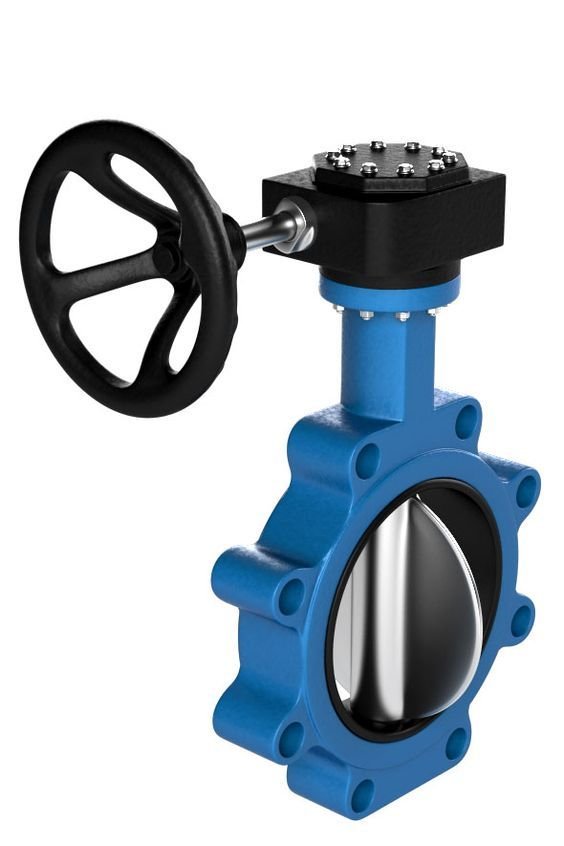
For industrial projects involving large pipeline connections, our flanged butterfly valve products can be considered alongside their technical specifications.
Cv of Concentric and Triple Offset Butterfly Valves
Valve geometry can significantly influence the flow characteristic.
A published reference table provides separate Cv data for concentric and triple offset butterfly valves. For example, at 90° open, the listed DN100 concentric valve has a Cv of 600, while the listed DN100 triple offset valve has a Cv of 420.
This demonstrates an important engineering point:
Valve size alone doesn’t determine Cv.
Disc geometry and sealing design matter too.
Triple offset valves are generally selected for demanding applications where their sealing and mechanical characteristics are more important than maximizing flow capacity alone.
Butterfly Valve Cv and Flow Control
Butterfly valves can be used for both isolation and throttling, but their suitability depends on the valve design and application.
For isolation service, the valve is normally either:
- Fully open, or
- Fully closed.
For control service, the valve may operate continuously at intermediate positions.
In control applications, engineers should examine the complete Cv curve rather than only the full-open value.
A valve that has a full-open Cv of 5,000 doesn’t necessarily provide good control at 20% or 30% opening.
The operating range matters just as much as maximum capacity.
How to Select a Butterfly Valve Using Cv
A practical selection checklist includes:
| Parameter | Required Information |
|---|---|
| Fluid | Water, air, steam, chemicals, etc. |
| Flow rate | Minimum / normal / maximum |
| Pressure | Upstream and downstream |
| Pressure drop | Allowable ΔP |
| Temperature | Operating range |
| Valve size | Pipeline and required flow |
| Valve type | Concentric, double offset, triple offset |
| Seat | EPDM, NBR, PTFE, metal |
| Connection | Wafer, lug, flanged |
| Operation | Manual, electric, pneumatic |
For final selection, ask the manufacturer for:
- Cv/Kv table
- Flow characteristic curve
- Pressure-loss curve
- Torque data
- Pressure rating
- Temperature rating
- Material specifications
Common Mistakes When Reading a Butterfly Valve Cv Chart
Mistake 1: Assuming Cv Is Linear
It isn’t necessarily linear with disc angle. Published reference data clearly show nonlinear changes in Cv.
Mistake 2: Using Full-Open Cv for Every Condition
A full-open Cv doesn’t describe the valve’s capacity when partially open.
Mistake 3: Ignoring Fluid Properties
Water, oil, chemicals, air, and steam require different sizing considerations.
Mistake 4: Choosing a Valve Solely by Pipe Size
Pipeline diameter is important, but flow requirement and pressure drop must also be considered.
Mistake 5: Treating Generic Cv Data as Certified Product Data
Reference charts are useful for preliminary engineering. The manufacturer’s actual Cv data should be used for final design.
Frequently Asked Questions
What is a butterfly valve Cv chart?
It is a table or curve showing the flow coefficient of a butterfly valve at different valve sizes and opening positions.
What does Cv mean on a butterfly valve?
Cv is a flow-capacity coefficient. In U.S. customary units, it represents the flow of water in gallons per minute through a valve with a 1 psi pressure differential.
Does a higher Cv mean better valve performance?
Not necessarily. A higher Cv means greater flow capacity under the defined conditions. The appropriate Cv depends on the required flow, pressure drop, and control range.
Does butterfly valve Cv change with opening angle?
Yes. Cv generally increases as the disc opens, but the relationship is not linear. Published butterfly valve data demonstrate substantial changes in Cv across different opening angles.
How do I calculate the required Cv?
For liquid service, use the required flow rate, specific gravity, and allowable pressure drop in the appropriate valve-sizing equation. Then compare the result with the manufacturer’s Cv data.
What is the difference between Cv and Kv?
Cv uses U.S. customary flow and pressure units, while Kv uses metric units. Both describe valve flow capacity.
Can I use a butterfly valve Cv chart to select an actuator?
No. Cv describes flow capacity, while actuator selection depends primarily on valve torque, differential pressure, seat friction, operating temperature, and the valve’s torque curve.
Should I use a generic butterfly valve Cv chart for final valve selection?
No. Generic charts are useful for preliminary estimates. Final selection should be based on the exact manufacturer’s Cv/Kv data for the selected valve design and operating conditions.
Conclusion
A butterfly valve Cv chart is an important engineering tool for understanding flow capacity and selecting an appropriately sized valve. Cv connects the required flow rate with pressure drop and provides a practical way to compare valve capacity.
The most important point is that Cv isn’t determined by valve diameter alone. Valve design, disc position, internal geometry, and operating conditions all matter. Published reference data show that Cv can increase dramatically as a butterfly valve moves toward the fully open position.
For preliminary selection, a Cv chart can quickly help identify an appropriate valve size. For final engineering decisions, however, always use the manufacturer’s certified Cv/Kv data, pressure-loss curves, and operating specifications.
That approach helps ensure the selected butterfly valve provides the required flow without creating unnecessary pressure loss or poor control characteristics.