
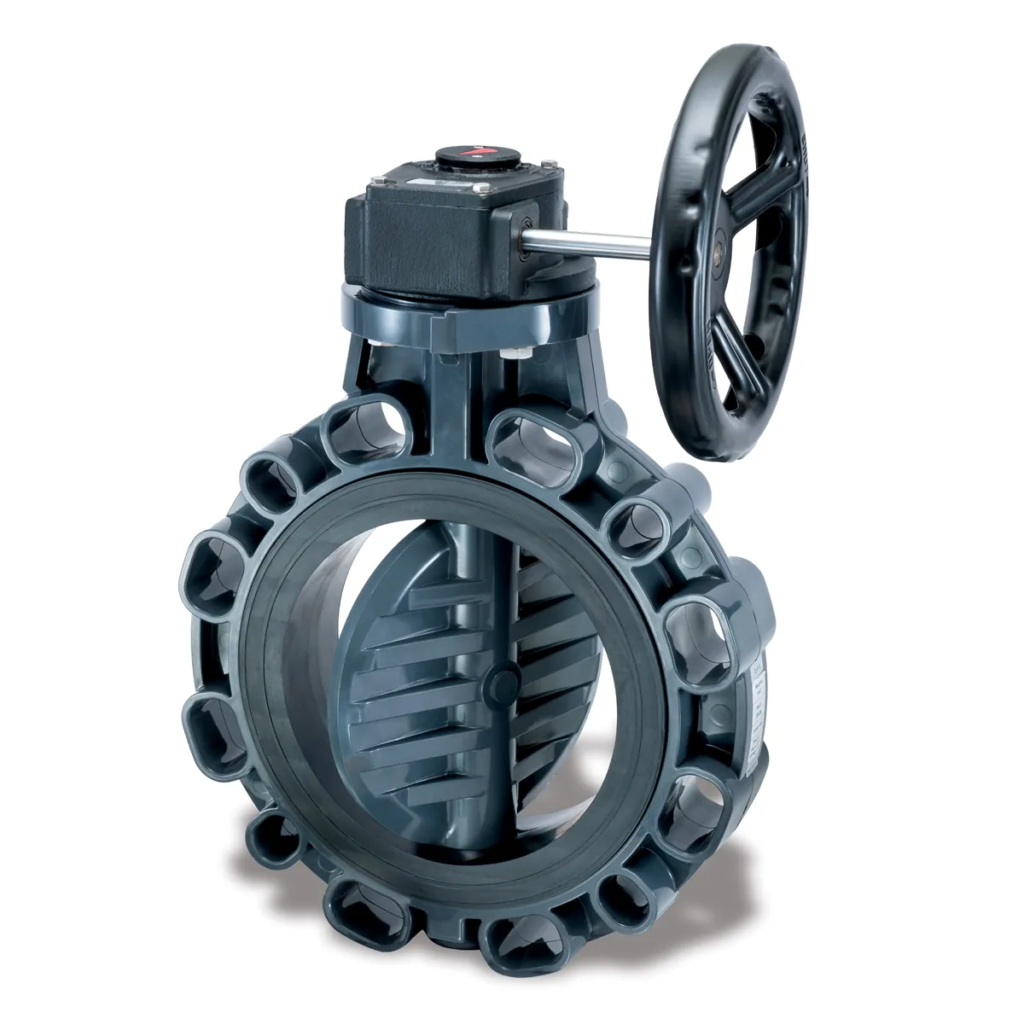
What Is a Butterfly Valve Sizing Calculator?
A butterfly valve sizing calculator is a tool used to estimate the appropriate valve size and flow capacity for a piping system based on operating conditions such as flow rate, pressure drop, fluid properties, and valve opening.
Choosing a butterfly valve isn’t simply a matter of matching the valve DN to the pipeline diameter. The valve must provide enough flow capacity while maintaining acceptable pressure loss and, when used for throttling, a suitable operating range.
For liquid applications, valve sizing is commonly based on Cv or Kv. These flow coefficients describe the capacity of a valve under defined pressure conditions.
A proper sizing process considers:
- Required flow rate
- Upstream pressure
- Downstream pressure
- Allowable pressure drop
- Fluid specific gravity
- Fluid temperature
- Valve opening
- Valve type
- Pipeline size
- Control requirements
For final selection, manufacturer-specific Cv/Kv data should always be used.
How Does a Butterfly Valve Sizing Calculator Work?
The basic principle is to determine how much flow the valve needs to pass at an acceptable pressure drop.
For liquid service, a commonly used Cv relationship is:
Where:
- Cv = required flow coefficient
- Q = flow rate in US gallons per minute
- SG = specific gravity
- ΔP = pressure drop across the valve in psi
For metric calculations, Kv is commonly used:
Here, the units of Q and ΔP must follow the convention used by the applicable Kv equation.
The calculator then compares the required flow coefficient with the valve manufacturer’s Cv/Kv chart.
Simple Example
Suppose a water system requires:
- Flow = 500 GPM
- Specific gravity = 1.0
- Allowable pressure drop = 4 psi
Then: Cv=50041=250
The required flow coefficient is approximately 250.
The next step isn’t simply to choose any valve with a full-open Cv above 250. You should also check the expected operating position and the manufacturer’s flow curve.
7 Key Inputs for Butterfly Valve Sizing
A reliable calculator needs more than just pipe diameter.
1. Flow Rate
Flow rate is usually the starting point.
Specify:
- Minimum flow
- Normal flow
- Maximum flow
Sizing only for normal flow may leave insufficient capacity during peak operation.
2. Pressure Drop
Determine how much pressure loss can be allocated to the butterfly valve.
If the allowable pressure drop is too low, a smaller valve may not provide enough capacity.
If the allowable pressure drop is unnecessarily high, the valve may consume excessive pump head.
3. Fluid Type
Water is relatively straightforward, but other fluids require additional information.
Common media include:
- Drinking water
- Cooling water
- Wastewater
- Seawater
- Oil
- Air
- Steam
- Chemical solutions
Fluid density, viscosity, temperature, and compressibility can affect sizing.
4. Specific Gravity
For liquid applications, specific gravity helps account for fluid density.
Water is approximately SG = 1 under standard reference conditions.
Oil and chemical fluids may have significantly different values.
5. Valve Opening
This is particularly important for control applications.
A butterfly valve’s Cv generally changes substantially with disc position.
A valve with a large full-open Cv may have a much smaller Cv at partial opening.
Therefore, a sizing calculator should ideally evaluate the valve at the intended operating position rather than only at 100% open.
6. Pipeline Size
Pipeline diameter is important, but it shouldn’t be the only sizing criterion.
For example, a DN300 pipeline doesn’t automatically mean a DN300 butterfly valve is the optimal control valve.
Engineers should check:
Flow rate + pressure drop + required Cv + operating range + pipeline size
7. Valve Type
Different butterfly valve designs have different flow characteristics.
Common options include:
- Concentric butterfly valve
- Double offset butterfly valve
- Triple offset butterfly valve
- Wafer butterfly valve
- Lug butterfly valve
- Flanged butterfly valve
The selected manufacturer’s Cv/Kv data should be used for the specific design.
Butterfly Valve Sizing Calculator Example
Consider a water pipeline with the following conditions:
| Parameter | Value |
|---|---|
| Fluid | Water |
| Flow rate | 500 GPM |
| Specific gravity | 1.0 |
| Allowable pressure drop | 4 psi |
| Service | Flow control |
Using the simplified liquid equation: Cv=50041 Cv=250
The required valve must therefore provide a suitable Cv around this value at the intended operating condition.
The final valve shouldn’t be selected based on this number alone.
The engineer should check:
- Full-open Cv
- Cv at normal opening
- Maximum flow
- Minimum flow
- Valve authority
- Pressure recovery
- Cavitation risk
- Manufacturer’s recommended operating range
Butterfly Valve Size vs Cv
Valve diameter and Cv are related, but they’re not identical.
A larger valve generally has greater flow capacity, but the actual Cv depends on internal geometry.
For example, published reference data for concentric butterfly valves show that full-open Cv rises significantly as nominal valve size increases. A reference table lists full-open Cv values of approximately 600 for DN100, 1,579 for DN150, 3,136 for DN200, and 8,250 for DN300. These are reference figures rather than universal values.
This illustrates why a sizing calculator should use actual manufacturer data rather than assuming a fixed Cv-to-DN relationship.
How Valve Opening Affects Sizing
A butterfly valve doesn’t necessarily provide proportional flow control.
For example, a published reference table gives the following values for one concentric valve design:
| DN100 Opening | Reference Cv |
|---|---|
| 30° | 36 |
| 40° | 78 |
| 50° | 139 |
| 60° | 230 |
| 70° | 364 |
| 80° | 546 |
| 90° | 600 |
The values increase rapidly as the valve approaches the fully open position.
Therefore, if a valve is expected to operate at only 30–40% open during normal conditions, selecting it based solely on its full-open Cv can produce poor results.
For throttling applications, the preferred approach is generally to select a valve that operates within a useful middle portion of its travel under normal conditions.
Butterfly Valve Sizing for Water Systems
Water is one of the most common butterfly valve applications.
Typical systems include:
- Municipal water supply
- Drinking water treatment
- Cooling water
- HVAC
- Irrigation
- Wastewater
- Fire protection
- Desalination
For these applications, the sizing procedure is usually:
Step 1: Establish Flow
Determine minimum, normal, and maximum flow.
Step 2: Establish Pressure
Determine upstream and downstream pressure.
Step 3: Set Allowable Pressure Loss
Determine the maximum pressure drop available for the valve.
Step 4: Calculate Cv or Kv
Use the appropriate liquid-sizing equation.
Step 5: Select Valve Size
Compare the required Cv with manufacturer data.
Step 6: Check Operating Position
Make sure the valve won’t operate excessively close to either fully closed or fully open during normal conditions.
Butterfly Valve Sizing for Seawater and Desalination
Seawater requires additional consideration because of its chloride content and corrosive nature.
For desalination applications, consider:
- Seawater density
- Temperature
- Chloride concentration
- Valve body material
- Disc material
- Seat material
- Pressure rating
- Corrosion protection
Common materials include duplex stainless steel, super duplex stainless steel, aluminum bronze, and specially coated ductile iron.
Hydraulic sizing still depends on flow and pressure drop, but material selection becomes equally important for service life.
Butterfly Valve Sizing for Air and Gas
Gas sizing is different from liquid sizing because gases are compressible.
The calculation must consider:
- Absolute upstream pressure
- Downstream pressure
- Temperature
- Molecular weight or specific gravity
- Compressibility
- Flow rate
- Choked-flow conditions
A liquid Cv formula shouldn’t simply be applied to gas service.
For critical gas applications, use a recognized valve-sizing method and the manufacturer’s gas-sizing data.
Butterfly Valve Sizing for Steam
Steam applications require still more care.
Important parameters include:
- Steam pressure
- Temperature
- Mass flow
- Saturated or superheated condition
- Pressure drop
- Choked flow
- Required valve opening
High-temperature steam applications may also require double-offset or triple-offset butterfly valves with appropriate metal seating and high-temperature materials.
Butterfly Valve Sizing and Pressure Drop
Pressure drop is central to valve sizing.
If the selected valve has insufficient flow capacity:
Flow resistance ↑ → Pressure loss ↑ → Available system pressure ↓
This can cause problems such as:
- Reduced downstream flow
- Higher pump requirements
- Increased energy consumption
- Poor process performance
However, minimizing pressure drop isn’t always the only objective.
For control valves, sufficient pressure drop may be required to provide effective control authority.
The correct target is therefore appropriate pressure drop, not necessarily the lowest possible pressure drop.
Butterfly Valve Sizing Calculator and Valve Authority
Valve authority is important when a butterfly valve is used for throttling.
A commonly used expression is:
Where:
- N = valve authority
- Δpv = pressure drop across the valve
- Δpc = pressure drop across the rest of the circuit
A very low valve authority can make flow control unstable or less responsive.
Therefore, a good calculator should consider not just the valve’s maximum Cv, but also its expected role in the entire hydraulic system.
Butterfly Valve Sizing vs Pipe Size
A common misconception is:
Pipe DN = required valve DN
This works reasonably often for isolation service, but it isn’t necessarily correct for throttling.
For example, a DN200 pipe could potentially use a DN200 butterfly valve for isolation. But if the valve is primarily a control device, the best size depends on:
- Flow rate
- Pressure drop
- Cv
- Control range
- Valve characteristic
- Required operating position
A smaller valve can sometimes provide better control, provided the velocity and pressure-drop limits remain acceptable.
How to Choose Between Wafer, Lug, and Flanged Butterfly Valves
Connection style normally doesn’t determine Cv by itself, but it matters for installation and system design.
Wafer Butterfly Valve
Good for:
- Compact installations
- General water service
- Cost-sensitive projects
Lug Butterfly Valve
Good for:
- Maintenance isolation
- End-of-line applications
- Flexible installation
Flanged Butterfly Valve
Good for:
- Large pipelines
- Industrial water systems
- Pump stations
- Desalination
- Heavy-duty applications
For projects requiring a robust flanged connection, you can also view our flanged valve product range.
Butterfly Valve Sizing Calculator and Actuator Selection
Sizing the valve and sizing the actuator are two different calculations.
The sizing calculator determines hydraulic capacity, usually through Cv/Kv.
Actuator selection requires torque data.
The actuator calculation should consider:
- Breakaway torque
- Running torque
- Seating torque
- Differential pressure
- Seat material
- Temperature
- Safety factor
A valve with an appropriate Cv can still have an incorrectly sized actuator.
7 Common Butterfly Valve Sizing Mistakes
1. Selecting by DN Alone
Nominal pipe size doesn’t establish the required flow capacity.
2. Using Full-Open Cv Only
Control applications require consideration of the actual operating position.
3. Ignoring Maximum Flow
Normal flow may not represent peak system requirements.
4. Ignoring Pressure Drop
A valve that passes the required flow may still consume too much pump head.
5. Using Liquid Equations for Gas
Compressible fluids require different sizing methods.
6. Ignoring Fluid Temperature
Temperature affects density, viscosity, and material performance.
7. Relying on Generic Charts for Final Selection
Generic data are useful for preliminary sizing. Manufacturer-specific data should be used for final engineering.
Butterfly Valve Sizing Calculator: Quick Selection Checklist
Before ordering a butterfly valve, confirm:
| Item | Check |
|---|---|
| Fluid | ✓ |
| Minimum flow | ✓ |
| Normal flow | ✓ |
| Maximum flow | ✓ |
| Upstream pressure | ✓ |
| Downstream pressure | ✓ |
| Allowable pressure drop | ✓ |
| Temperature | ✓ |
| Specific gravity | ✓ |
| Valve size | ✓ |
| Cv/Kv | ✓ |
| Valve opening | ✓ |
| Seat material | ✓ |
| Body/disc material | ✓ |
| Pressure rating | ✓ |
| Actuator torque | ✓ |
This checklist helps prevent common sizing errors and gives the valve supplier enough information to recommend an appropriate configuration.
Frequently Asked Questions
What is a butterfly valve sizing calculator?
It’s a tool used to estimate the appropriate butterfly valve size and flow capacity from parameters such as flow rate, pressure drop, fluid properties, and valve operating conditions.
Can I size a butterfly valve using pipe diameter alone?
Not for all applications. Pipe diameter is important, but flow rate, pressure drop, Cv/Kv, and operating position must also be considered, particularly when the valve is used for throttling.
What information do I need for butterfly valve sizing?
At minimum, you generally need the fluid, flow rate, upstream and downstream pressure or allowable pressure drop, temperature, and specific gravity for liquid service.
What is Cv in butterfly valve sizing?
Cv is a flow coefficient that describes the flow capacity of the valve under specified conditions. It is widely used for valve sizing in U.S. customary units.
Should I use Cv or Kv?
Either can be used as long as the correct units and sizing equations are applied. Cv is common in U.S.-based engineering, while Kv is common in metric applications.
How much pressure drop should I allow across a butterfly valve?
There isn’t one universal value. It depends on the system, pump head, required flow, control requirements, and valve application.
Can the same sizing calculator be used for water and gas?
No. Gas is compressible, so gas-service sizing requires different equations and additional parameters such as absolute pressure, temperature, and compressibility.
Does valve opening affect butterfly valve sizing?
Yes. Cv can change significantly with disc position. For control applications, the valve should be evaluated at its expected normal and maximum operating positions.
How do I select the actuator after sizing the valve?
Use the manufacturer’s torque data. Actuator selection depends on breakaway, running, seating, and unseating torque rather than Cv alone.
Conclusion
A butterfly valve sizing calculator is useful for turning operating conditions into a practical valve selection. The basic process is to establish flow rate and allowable pressure drop, calculate the required Cv or Kv, compare that requirement with manufacturer data, and then verify the valve’s operating range.
For water and other liquid systems, the process can be relatively straightforward. Gas, steam, high-pressure, high-temperature, and corrosive applications require more detailed engineering analysis.
Most importantly, don’t select a butterfly valve based only on pipeline diameter. A reliable selection should consider flow rate, pressure drop, Cv/Kv, valve opening, fluid properties, valve design, materials, pressure rating, and actuator torque.
For final procurement, always verify the calculation against the exact manufacturer’s technical data. This provides a much safer and more accurate result than relying on a generic sizing chart alone.